Byun Hee-won, The Chosun Daily Chun Gwang-young Unveils New Hanji Works in London
October / 20 / 2026
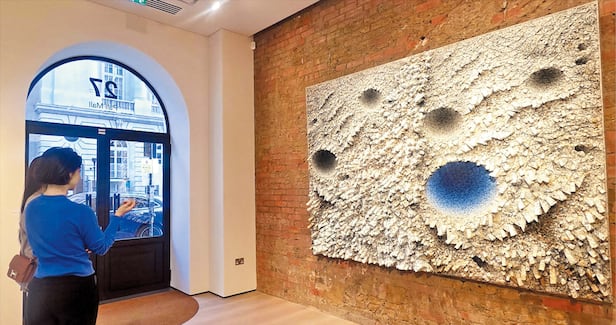
At the Sundaram Tagore Gallery in London, UK, visitors look at Jeon Kwang-young's 'Assembly 26-SE086' (2026, 194×260 cm). The screen, rising with overlapping grayish-white triangular packages, has several pits scattered across it. Among them, the blue pool darkens toward the inside, making its depth difficult to gauge. From a distance, it resembles an unfamiliar planet's surface, but upon approaching, the paper's wrinkles, knots, and printed text become visible. /Courtesy of Byun Hee-won

At the Sundaram Tagore Gallery in London, UK, visitors look at Chun Kwang-young's 'Assembly 26-SE086' (2026, 194×260 cm). The screen, rising with overlapping grayish-white triangular packages, has several pits scattered across it. Among them, the blue pool darkens toward the inside, making its depth difficult to gauge. From a distance, it resembles an unfamiliar planet's surface, but upon approaching, the paper's wrinkles, knots, and printed text become visible. /Courtesy of Byun Hee-won


As one approaches the text, sentences fracture. Letters hide or tilt within folded and bound paper. Stepping back reveals a rugged terrain. Chun Gwang-young’s (82) *Jip* (Assembly) is a work where attempting to read turns the piece into a painting, and trying to view it as a painting makes the letters persistently intrude. This landscape, built from pages of classical Chinese texts, now incorporates Hangul.


The solo exhibition *Jip: Paper and the Memory of Time*, which opened on October 9 at the Sundaram Tagore Gallery in London, features 33 works—mostly new pieces created this year. The artist printed *Hunminjeongeum Haeryebon* and other texts on hanji (traditional Korean paper) and added Hangul to his abstract compositions, which he has pursued for over 30 years. The gallery, with bases in New York, London, and Singapore, has introduced works by photographers Annie Leibovitz and Sebastião Salgado, as well as Japanese painter Senju Hiroshi. Its London space is located on Pall Mall Street in St. James’s, central London, an area dense with art dealers and galleries.


Chun’s name is not unfamiliar abroad. He held a solo exhibition at the Brooklyn Museum in New York in 2018–2019 and participated in an official collateral event at the Venice Biennale in 2022. In London, both the Victoria and Albert Museum (V&A) and the British Museum hold his works. According to a source from the artist’s side, five new pieces will soon join the collections of the Centre Pompidou, Cleveland Museum of Art, Brooklyn Museum, and British Museum.


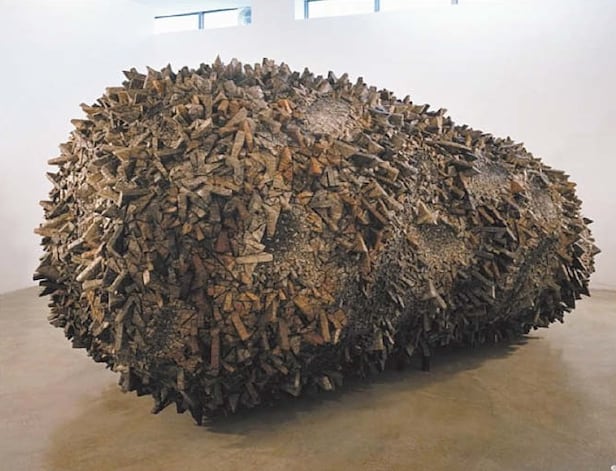
The Pompidou Center in Paris, France, is scheduled to acquire 'Assembly 06-JN025'. Dimensions: 400 x 200 x 200 cm. /Courtesy of Jeon Kwang-young Studio

The Pompidou Center in Paris, France, is scheduled to acquire 'Assembly 06-JN025'. Dimensions: 400 x 200 x 200 cm. /Courtesy of Chun Kwang-young Studio


The surface of *Jip* is a dense zone of triangular bundles. Pieces of varying sizes and heights interlock tightly, carving valleys and raising peaks. Some areas resemble dense scales, others deep fissures like cracked earth. Protruding edges catch light while shadows pool below, creating contrasts within the same hue. Instead of painted perspective, the paper fragments’ varying heights generate depth on the canvas.


In the exhibition space, there are moments when paper appears harder than stone or wood. In *Jip 26-JL046* (2026), elongated black and brown bundles extend beyond the canvas. Beneath a surface resembling densely stacked charred wood fragments, serrated shadows fall. The circular work *Jip 26-JL047 (STAR7)* (2026), 120 cm in diameter, evokes the surface of another planet. Grayish-white fragments rise amid scattered craters, with a single blue pool whose depth is impossible to gauge.


The creation process repeats wrapping, binding, and gathering. Triangular polystyrene pieces are wrapped in hanji torn from old classical Chinese texts, then bound with cords twisted from hanji. Thousands of these bundles are pieced together to form undulating surfaces. Letters fracture along folded edges and are severed between knots. As thin paper accumulates thickness, the artwork protrudes toward the viewer even when hung on a wall. This method, ongoing since 1995, has expanded from wall-based reliefs to large-scale sculptures and installations. Melissa Chu, director of the Guggenheim Museum, noted, “Every work reveals a ‘sense of making,’ and for viewers, how it was created becomes a puzzle.”


The artist’s inspiration stems from medicinal pouches hanging from the ceiling of his childhood herbal shop. He compared the “act of wrapping” to Western boxes and Korean bojagi (wrapping cloths). While boxes impose standardized forms, bojagi adapt to their contents and allow room for additions. This flexible vessel now embraces Hangul.


In these new works, the paper itself has evolved. The Hongcheon-born artist, who calls himself a “Gangwon Province country bumpkin,” selected paper handmade by a Wonju artisan. The classical texts carried not only letters but also the patina of time accumulated through human touch. Now, new paper holds records of the present. “If my earlier works expressed our history and identity,” he said, “now I aim to tell the story of us today.”


Charlotte Horlyck, professor of Korean art history at SOAS University of London and former V&A curator, remarked, “The characters and images are organically combined,” adding, “Even if the text cannot be read, the work itself is fully appreciable.” Following the paper’s creases, colors, light, and shadows, unfamiliar scripts gradually become part of the landscape. The exhibition runs until December 5.

Article from The Korea Times Chun Kwang-young's crystalline 'hanji' wonderland in Seoul
December / 15 / 2024


[The Korea Times]

Pencil Journal Chun Kwang Young
January / 20 / 2023

The Korean artist, Chun Kwang Young has been creating reliefs, large scale sculptures and installations for over thirty years named ‘Aggregations.’  These structures are made from thousands of small packages wrapped in handmade text covered Hanji (Korean mulberry paper) and tied together with threads of the paper. This organic material is a champion of ecological reproduction as the tree does not need to be cut down to harvest the paper-making fibers. The process of collecting and dismantling pages of old books made of Hanji followed by the meticulous process of assembling and wrapping each package demands a huge amount of patience. They are an art of healing, presented to the audience as a form of reflection on socio-ecological subjects. 

Chun Kwang Young’s recent exhibition at the Venice Biennale ‘Times Reimagined’ confronts the devastating effect humanity has had on our planet. These sculptures are a call to action on the rapid decline of our ecosystems, mass consumption and the destructive levels of pollution in our atmosphere.


Installation views “Chun Kwang Young: Times Reimagined”, 2022, Palazzo Contarini Polignac, Venice. Copyright CKY Studio. Photo: © Alice Clancy


Could you talk about growing up in South Korea and how this might have influenced you and your passion for art?

Looking back, my childhood made a huge impression on how I perceive the world, particularly the beautiful days growing up in my village, the panic of evacuation at the age of 5 due to the outbreak of the Korean War; the lonely study time in Seoul where I had my first exposure to art; and the first prize I won in the national art competition, which encouraged me to pursue higher education in art college. When I was studying, my father heavily opposed my decision to pursue art. He was fully convinced that the only way to be successful was to study business or law. It was the love of my grandparents that supported me through all these difficulties. I still remember the food packed in ‘bojagi’ (a Korean wrapping cloth) that my grandmother prepared for me, which always brought me nostalgic memories of the village Hongcheon when I studied abroad. 

After you finished your studies, you focused on Abstract Expressionism. How did this come about and when/why did you shift your creative practice?

My first encounter with American abstract expressionism was in the College of Fine Arts at Hongik University in Seoul. After graduation, I wanted to differentiate myself from the majority of seniors who studied in Europe (especially Paris), so I chose to go to the United States where I learnt more about this genre of art and fell in love with it at my graduate school. At the time, abstract expressionism resonated with my inner desire for free expression, accentuated by the astonishing reality of social upheavals in contrast with rosy ideals. In a way abstract expressionism worked best to express the chaos and struggles of the world I lived in.

However, there had always been a haunting voice in my mind, asking myself if there could be a better way to reveal my own identity, both in form and in spirit. In 1995, I suffered from a nasty cold and it brought back childhood memories of the medicine packages wrapped in mulberry paper hanging from the ceiling of the traditional Korean herbal clinic. It was during this time that I began to explore the creative practice of working with this material.

Why did you begin working with mulberry paper? Could you talk about why this material is important to you?

Hanji (Korean mulberry paper) is much more than a material, because it has been part of my whole life. The hanok (traditional Korean style house) I lived in when I was born was built with mud walls covered with hanji; all the books used in seodang (village school) where I learnt the Thousand Character text were made in hanji; and the herbal medicines hanging from the ceiling in my uncle’s oriental medicine shop were wrapped in hanji.

Hanji is a medium for me to express my perception and contemplation of social, cultural and ecological struggle and reconciliation. Moreover, I see the life cycle of living entities through the production and recycling of the mulberry paper.

For the past 30 years, you have researched and practiced under the theme of interconnectedness. Could you explain further what this means?

In ecology, interconnectedness is an absolute factor for the reproduction and survival of all living things, including humans, and it means an essential requirement for ensuring biodiversity and enhancing sustainability in adverse conditions such as climate change. Therefore, interconnectedness is the healing DNA that overcomes the oppression and loss that arise from social disconnection, both in space and in time. It is also a thought-provoking process looking closely into the durability and recycling of the mulberry paper which reveals the natural laws of ecology facilitated by a biodiverse environment.

Your recent exhibition at the Venice Biennale ‘Times Reimagined’ showcases your extraordinary monumental sculptures and installations, could you talk about your creative process and what ‘Aggregation’ means?

‘Aggregation’ was born from my concern of the increasing level of heinous crimes, terrorism, wars, and the destruction of the natural environment. It was important that my work responded to this.

Hanji triangular bojagi (a Korean wrapping cloth) are hand-wrapped and tied one by one, so that none of them are exactly the same. This tenacious work embodies the mindset of covering the wounds of each individual, nature, and all the living beings. In some cases, I use discarded trash that is not easily recycled in nature to fill the triangular-shaped package wrapped in Hanji. In other words, it is a way to heal and reuse environmentally polluting materials.

Most of the paper existed as a book before it was used for artwork. I acquire old books, mostly genealogy books, disassemble them, and make triangular-shaped packages with the paper that has been passed on through many hands in the process of paper-making, selling, reading and recycling. 

On average how long does it take to make each relief? 

The smallest work displayed in Venice this time, for instance 195cm x 131cm, takes about two months to complete if all materials are ready. 

Could you talk about the central themes of the exhibition and why it was important for you to share your work with the public? 

‘Times Reimagined’ is a periodic review of my practice through the more intense lens of ecology. Given the unique Renaissance-style palazzo, most of the large-scale installations required site-specific adaptation, which was not just a challenge but an exciting process of initiating a new dialogue between the works and the space. Furthermore, the audience reception and interaction breathed new life into my works, adding another layer of ‘aggregation.’


https://pencil-journal.co.uk/journal/chun-kwang-young/

by Judith Bar תרבויות משיקות אמנות קוריאנית עתיקת יומין וטוויסט אדריכלי מערבי ביאנלה 2022 בוונציה הפרייה כובשת עין
July / 31 / 2022

תרבויות משיקות

אמנות קוריאנית עתיקת יומין וטוויסט אדריכלי מערבי

ביאנלה 2022 בוונציה

הפרייה כובשת עין

פורסם במדור- , , 

צילום – Alice Clancy

אמנות נייר קוריאנית, הקרינה, בייחודה, על האדריכל איטלקי Stefano Boeri.

המזרח, במקרה זה, קוראה הדרומית ואמנות נייר התות עתיקת היומין, ה- HANJI, בעוצמתה הפנימית, כמו לא יכלה שלא לבוא לידי ביטוי בביאנלה האחרונה באיטליה בביתן 'מנורת רחוב' , תרצו 'פנס רחוב' מודרני.

Chun Kwang Young , בן 78, עטור פרסים, הציג תערוכה מרשימה בביאנלה האחרונה בוונציה – פסלים ומיצגים מנייר התות, תחת הכורת – זמנים מדומיינים מחדש – בארמון  Palazzo Contarini Polignac .

מזה 30 שנהChun  יוצר בתפיסתו את ההדדיות הבאה לידי ביטוי בין בני אדם לבין הערכים הסוציו -אקולוגיות הקורים, והשפעתם על המשך החיים של היצורים החיים.


Chun Kwang Young – צילום באדיבות JIYOUN PUBLIC ART,SEO,

,Stefano Boeri אדריכל איטלקי ומרצה בנושא תכנון עירוני במילנו, עוסק גם בעיצוב פנים ובעיצוב מוצרים בפוקוס תמידי גאופוליטי ובהשפעות ההדדיות בין סביבה וחיי בני אדם, בבדיקת תופעת ההתיישבות האורבנית.  לדוגמא, היערות האנכיים בתכנונו הביאו לפרסים שהוענקו לו ב-2014, 2015.


               צילום – Guoing Jiang

אדריכל Stefano Boeri – צילום באדיבות אדריכל סטפנו בוארי

בעקבות אימפאקט אמנותו של Chun והתרשמותו של Boeri מתרבות ייצור נייר התות הדרום קוריאנית, המכונה גם "נייר אלף השנים" )בהיותו מאד חזק(, תכנן ועיצב את 'בית Hanji',  מעץ, אמנם, בתבנית  'נייר-עץ בארכיטקטורה' והנראה מרחוק כמו פנס. העיצוב חיכה מסורת קיפולי נייר בנוסח tangram  (משחק סיני של הרכבת צורות גיאומטריות). פשטות המבנה מתחקה למבנה גאומטרי מודולרי, ביצירת חללים במבנה גיאומטרי פשוט, לפי מסורת דרום קוריאנית או לפי מסורת של בתים במזרח. במקרה שלפנינו הבית בנוי מ-4 פירמידות. מבחוץ הבית נראה כמו "חפץ"יקר ערך וגם כמו מבנה לשחק בו, כאשר ביום, בלובן שלו, ובלילה באור, הכמו בוקע ממנו. "בית HANJI" מאיר בלילה את ארכיטקטורת הרנסאנס שמסביבו וביום, בזכות מאפייניו, הוא מייחד גם את עצמו וגם את סביבתו האדריכלית הרנסנסית.

'בית HANJI' הוצב בוונציה ב- Palazzo gardens ונצפה מתעלת Grand Canal. שימו לב! גם תערוכה הקוריאנית וגם 'בית HANJI' ניתן יהיה לבקרם מ-23 באפריל ועד 27.11.22 .

צילום – Guoing Jiang

האמנות של Chun Kwang Young  מוצגת  ב- וונציה ב- Palazzo Contarini Polignac . הנושא – PAPER BECOMES MANIFESTO (הנייר כמניפסט אקולוגי) .


צורת וירוס, לב מוגדל הסובל מזיהום, פטריה מעוותת, פלנטה מחוספסת ופצועה והלא ראויה לחיות עליה, זכרון דוגמת טבע שנהרס בגלל טכנולוגיה לטובת כלכלה מתקדמת,וגם נייר צבוע בצבעים הכמו מרפאים…

צילום באדיבות Chun Kwang Young ו-  CKY STUDIO


עבור Chun, לאמנות גם תפקיד מדיטטיבי, לחשב מה אנו כבני אדם עושים, וגם מושא אסטטי. הנייר בו הוא משתמש מיוצר לפי המסורת בעבודת יד. האמן משתמש גם בנייר ספרים ישנים, כך שגם תכנם הוא חיבור אינהרנטי עם העבר ותוכנם של בני אדם.


צילום – Guoing Jiang

הדיאלוג של Boeri  vis a vis  Chun הוא מחאה פואטית להארת המניפסט האקולוגי הכואב של האדם.

קוראים יקרים, מוזמנים לצפות בווידיאו מטה. מעניין כיצד האמן הקוריאני מסביר אמנותו ועשייתו.


שימו לב! אם תבקרו בוונציה בקרוב, גם תערוכה הקוריאנית וגם 'בית HANJI' ניתן יהיה לבקרם עד 27.11.22 .

www.chunkwangyoung.com

www.stefanoboeriarchitetti.net


출처: https://www.hafatzim.com/hanji-art-chun-artist-and-boeri-architect-in-venice/

Designed by HANNET.COM